ASICA: a skin self-check research app
A research app on a tablet that helps people treated for melanoma check their own skin at home. Designed with patients and run in a six-month NHS pilot with twenty of them. I led the design and built the working prototype.
- 21 people interviewed before anything was built
- 20 patients used it at home for six months
- 15 of the 20 kept to their checks well
- 24 hours for a specialist nurse to phone back
What it is
A research project at the University of Aberdeen. ASICA is an app on a tablet that helps people who have been treated for melanoma, a skin cancer, to check their own skin at home every month.
People who have had melanoma are asked to check their skin between hospital visits. The research found that they saw the point of it, but did not feel equipped to do it properly or to keep it up.
The people
Patients. The app was designed with them. Before anything was built, the research team interviewed 21 people who had been treated for melanoma.
They wanted to be shown how to check, to be reminded when, and to be able to report what they found to a specialist who would answer quickly.
The whole process was then acted out in mock-up rooms by volunteers, a family doctor and a specialist nurse, to find the problems before any patient met them. The main lesson was to use clear, simple words, and the same words in the training as in the app.
What I built
I led the design of the app within the research group, and built the working prototype. Clinicians, patients and advocacy groups were involved throughout. The schools of medicine and computing led the project together, as part of the dot.rural Digital Economy Hub.
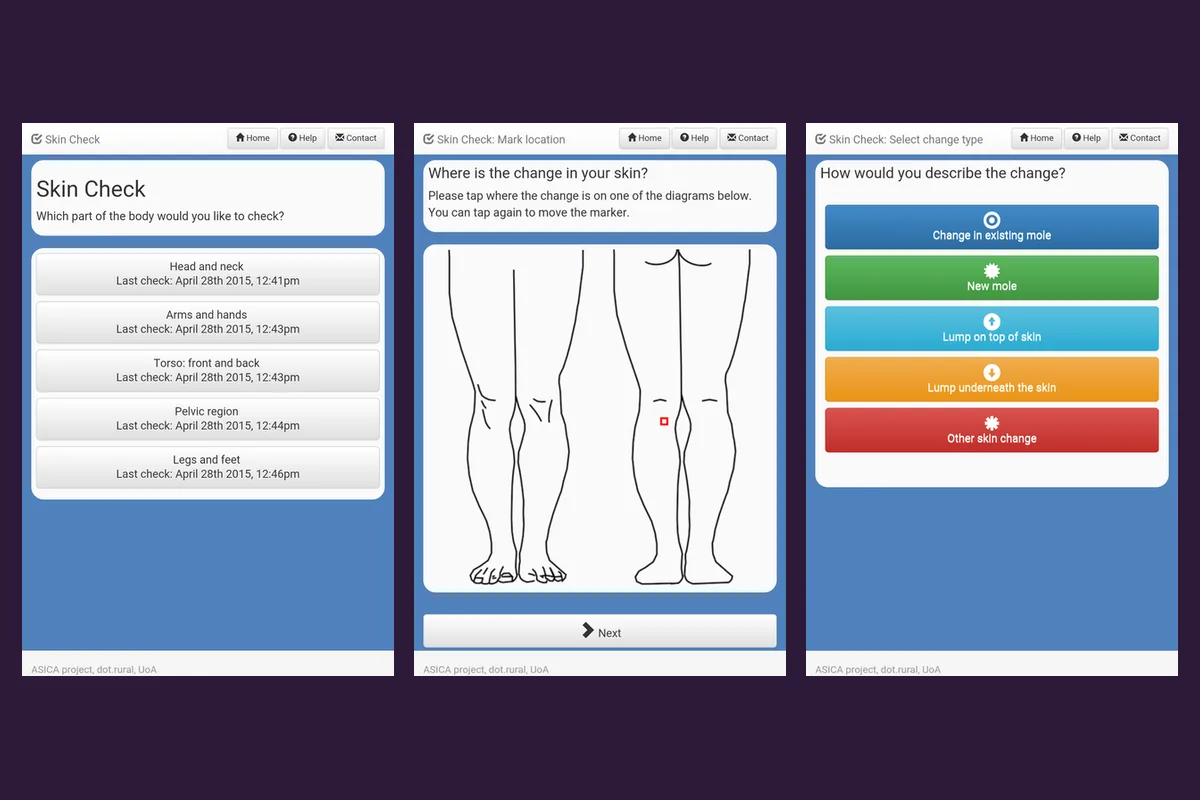
Checking the whole body in one go took hours. So I split the check into areas of the body. Each month the patient gets a reminder, and the app takes them through the check one area at a time, with a short film and a checklist for each. They can compare what they see with photographs of their own skin taken at the start.
I worked with Muckle Hen Productions on new films in a smaller, friendlier format.
If something has changed, they mark where it is on a diagram, describe it, photograph it and send a report to a specialist nurse. The nurse phones them within 24 hours.
I wrote the training sessions and materials for patients, and I helped to deliver them. I was one of the four who gathered and analysed the results.
What happened
Twenty people who had been treated for melanoma used it at home for six months, supported by their family doctors and a specialist nurse. It was a research pilot, not an NHS service.
Fifteen of the twenty kept to their checks well. Four checked less regularly and one withdrew. Patients were largely positive about using it.
Two people had skin surgery because of something they found during a check. One was a melanoma that had come back. The other was harmless.
It was a small pilot, and it showed what to fix. The photographs patients sent were often not clear enough for the nurse to judge, so advice on taking a good one was added to the app.
Where it is now
The pilot was published in the journal BMJ Open in 2015. A Cancer Research UK grant followed, to carry the work on.
Sources
- Murchie P, Allan JL, Brant W, Dennis M and others. Total skin self-examination at home for people treated for cutaneous melanoma: development and pilot of a digital intervention. BMJ Open, 2015.
- Cancer Research UK: a study using the ASICA app to help people who have had treatment for melanoma (ASICA Optimization Project).
What I did here
-
Web applications
Make bookings, records and everyday tasks easier for your staff and the people you support.
-
Surveys and research
A study planned, run, analysed and reported plainly.
-
Accessibility and user research
Find out what your people need, and make sure everyone can use the result.
For IT people: how it is built
Research tablet app for melanoma self-monitoring. University of Aberdeen, published in BMJ Open in 2015.
- Designed with patients and run in a six-month NHS pilot.
- An app for the Google Nexus 7 tablet. Reports, with photographs taken on the tablet, went to a secure remote server for review by a clinical nurse specialist.
- Developed under the Medical Research Council framework for complex interventions. Behaviour change techniques are built into the flow: prompts, demonstration, checklists and feedback.
- Pilot in NHS Grampian: 20 patients, six general practitioners and one nurse specialist. 15 adhered well. Two had lesions excised, one of them a recurrent melanoma.
- Murchie P, et al. BMJ Open 2015;5:e007993. Funded by the RCUK Digital Economy programme through the dot.rural hub at the University of Aberdeen.